
Inside the Isle of Wight County Most Wanted Program
The Isle of Wight Sheriff’s Office describes a Wanted Persons and Crime Line program with the Isle of Wight-Smithfield-Windsor Crime Line Board. It provides an official route for information about wanted-person locations and crime. The public-facing Sheriff page explains the program and links to the list; no names, photos, addresses, or case details are reproduced here.
The Sheriff says its list is not an official court record and does not confirm probable cause or current status. The linked online list currently displays an inactive notice dated October 10, 2023. The program page remains the proper place to read the agency’s own scope and safety instructions.
Isle of Wight County List Status
The Sheriff’s Wanted program page describes the agency-held channel. Its separate online list page states that the list is not currently active, with a date of October 10, 2023. No current name search, result count, or update schedule was visible in the research capture.
When a public roster is inactive, use OCIS to locate an eligible case and call the clerk to confirm status. The Sheriff’s page is a program link, not a substitute for the court record. A missing online list cannot answer whether a person has active process.
The Sheriff’s official program page describes its wanted-list channel.
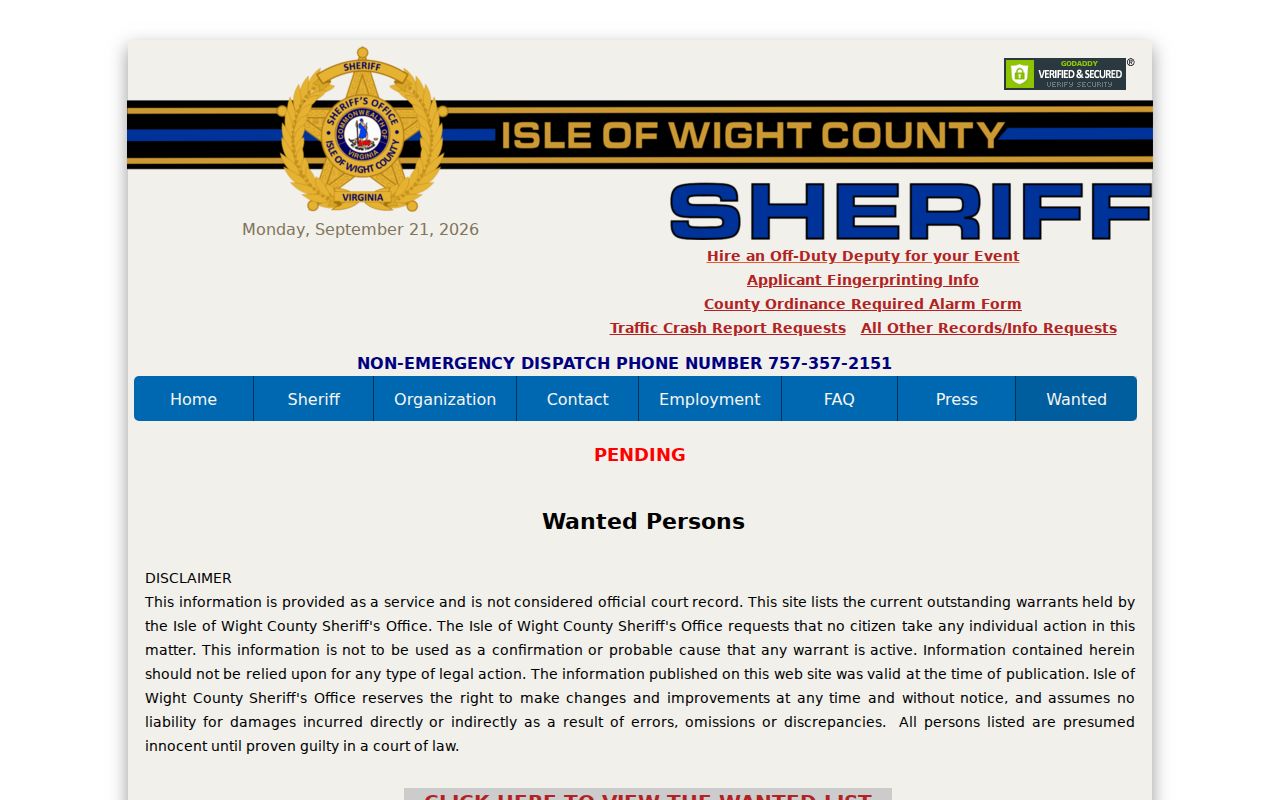
It links the agency program without requiring this page to host a roster.
How Isle of Wight County Most Wanted Lists Work
The Sheriff has not published selection rules, a fixed refresh interval, or a public reward schedule for this feature. The online roster is currently marked inactive, so no current names or count should be inferred. The agency page can still explain the program and its safety limits. For an actual case, the issuing clerk’s docket and the serving agency’s record are the sources to verify.
The Sheriff says it may occasionally feature a most-wanted person or list alongside its outstanding-warrant program. No selection criteria, fixed update cadence, or public reward schedule was posted. The linked roster is inactive at the source date noted above, so the page cannot be treated as a current roll call.
Note: A list entry is an agency snapshot, not a court-certified status; verify the underlying case with the issuing clerk before acting.
Crime Line Tips Are Separate From Warrant Checks
The Sheriff lists Crime Line at 1-888-562-5887, option 10. The service is described as anonymous, and a reward may be available if information leads to apprehension or conviction. The official page does not state an amount, cap, or payment method. The tip channel is for information about crimes or wanted-person locations, not a way to check the caller’s own status.
The Sheriff directs current-location information to dispatch and asks people not to take individual action. Smithfield’s page also warns readers not to contact or apprehend anyone listed.
Sending a Most Wanted Tip Safely
If you have information about a listed person or crime, use the official Crime Line route or call the Sheriff dispatch number listed by the agency. The Crime Line phone channel is described as anonymous. Do not send a tip to ask whether your own warrant exists; use the court or Sheriff records channel instead.
- Call 1-888-562-5887, option 10, for the Crime Line phone route.
- Share useful information with the program, not on a public page or social post.
- Do not approach, follow, or try to detain anyone; let law enforcement respond.
- Ask Crime Line staff how any eligible reward is handled; the public page gives no amount or timetable.
Key Point: Crime Line is a tip channel, not a warrant-status search; use it to report information and leave any response to law enforcement.
The Separate Web Form Has a Caution
The Sheriff distinguishes its web form from Crime Line and says the form is not as secure. P3 is another way to submit a tip, not a portal for looking up a name or checking a court date. For that reason, keep a tip limited to information meant for law enforcement. Use the court clerk, Sheriff’s records route, or an attorney for private status questions.
The Sheriff links a separate online tip form and expressly says it is not Crime Line and is not as secure. The P3 link is also a tip-submission product, not a warrant database. These tools accept information; they do not return a personal court status or replace a call to the clerk.
Keep a status question within the court, Sheriff records, or counsel channel. The Crime Line page gives the phone option and explains the boundary between the anonymous program and the separate web form.
How Most Wanted Differs From an Active Warrant
A most-wanted feature is a curated public program. An active warrant is a court process that has not been served, recalled, or otherwise cleared. The Sheriff’s program covers warrants held by that office and excludes town wanted persons unless later papers are assigned for service. These categories are not interchangeable.
| Feature | Most Wanted List | Active Warrant |
|---|---|---|
| Scope | Program feature selected by the agency | Process on a particular court or agency record |
| Who maintains it | Sheriff and local Crime Line program | Issuing court and serving agency |
| Current Isle status | Linked online list says inactive | Confirm with the clerk and agency |
| Next step | Use tip channels for information | Ask about counsel, court, bond, or recall |
Isle of Wight County Program Scope Is Limited
The Sheriff says its program lists warrants held by the Sheriff’s Office and does not include Smithfield or Windsor wanted persons unless later court papers are assigned for service. Smithfield has its own page and phone verification instruction. Windsor has no public warrant search located in the source sweep.
A countywide picture therefore requires more than one channel. The court clerk controls the docket; town police can answer a town-record question; the Sheriff can explain county service. The Crime Line is not the place to ask about a personal case.
When You Believe You Are Listed
For a personal status question, contact a lawyer and the court that owns the case. Ask the clerk whether process is active and what the judge requires. If the Sheriff holds service, its page describes surrender at the Sheriff’s Office, with transfer to Western Tidewater Regional Jail if bond cannot be set or paid. The page does not promise a specific result or release time.
Important: Do not approach anyone on a list; use counsel, the issuing clerk, or the Sheriff’s official contact route to ask about your own case.
Sheriff Surrender Guidance Has Limits
The Sheriff’s surrender description does not list an appointment system or promise a specific processing time. The public number for the jail differs from the magistrate number, and neither facility contact replaces the issuing clerk. Confirm where the court expects an appearance and which office holds service before traveling. If a case is from Smithfield or Windsor, also ask the town agency whether it has the local record.
The Sheriff’s Wanted program page says a person may surrender at the Sheriff’s Office in Windsor. In most cases, processing and bond may occur there; when bond cannot be set or paid immediately, transfer to Western Tidewater Regional Jail may follow. These instructions describe an agency route, not a promise that a specific person will be released or that every warrant can be handled at that office.
The public guidance does not publish an exact surrender window, required identification list, payment methods, or bond schedule. Call before traveling and ask the issuing clerk or counsel whether a court appearance is also required. A wanted-page entry and a surrender plan are separate from the anonymous Crime Line tip process.